
How To Bring Your Thoughts into Captivity
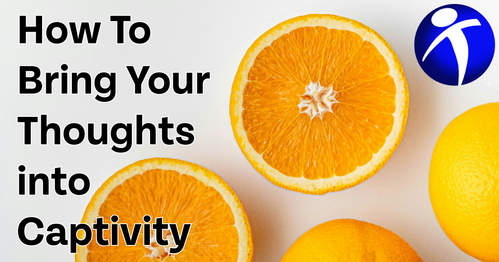
Don’t think about oranges. No, I don’t mean the color orange; I mean the fruit that is orange in color that goes by that name – the name “orange.” Don’t think about that round, orange fruit that grows on orange trees. You know the ones: those trees whose white blossoms are transformed by the tremendous design and power of God into globular, tart, tangy, sweet, orange-colored fruit. Don’t think about the way that oranges can be peeled, allowing you to remove their orange skin, revealing their orange-colored fruity flesh. Don’t think about the way that they can be cut into segments and placed in baggies for picnics and sport events. Definitely don’t think about those kids who put those segments into their mouths, hoping to show off their orange, toothless smiles. Remember, you’re not supposed to think about oranges. Don’t think about the way they sometimes have seeds and sometimes have navels. Don’t think about how they can be squeezed, yielding orange juice that is sometimes sold in cartons or bottles with pictures of oranges on the front. Just don’t think about any of that; don’t think about oranges.
How did you go? Now, you might have an iron will… or you might have found that oranges periodically popped into your mind as you read that paragraph. And, if you happen to like oranges, you might also be thinking about getting a snack.
Paul speaks about, “bringing every thought into captivity to the obedience of Christ” (2 Corinthians 10:5). The rationale behind this is that nearly everything that we do is preceded by a thought. Thoughts are powerful. Jesus said, “But those things which proceed out of the mouth come from the heart, and they defile a man. For out of the heart proceed evil thoughts, murders, adulteries, fornications, thefts, false witness, blasphemies” (Matthew 15:18-19). The thoughts of our heart determine whether we are pure or whether we are defiled.
Knowing this, some Christians attempt to win the battle of the mind by brute force. They know they shouldn’t think about oranges, so they set about thinking, “Don’t think about oranges!” They pray, “Lord, please help me not to think about oranges.” They listen to podcasts and read articles and books about not thinking about oranges. Then, inevitably, they find themselves thinking about oranges, and they feel like frauds and failures.
What these Christians fail to realize is that the battle of the mind can’t be won by taking a negative posture. It’s not some whack-a-mole game, where your only role is to attempt to squash each thought as it arises. No, the best way not to think about oranges… is to think about apples instead. The same Paul who encouraged us to bring our thoughts into captivity said, “Finally, brethren, whatever things are true, whatever things are noble, whatever things are just, whatever things are pure, whatever things are lovely, whatever things are of good report, if there is any virtue and if there is anything praiseworthy—meditate on these things” (Philippians 4:8). Christianity is not really about elimination; it’s about meaningful and beneficial replacement. The Bible never says “put off” without saying “put on” (e.g., Colossians 3:1-17). We can't renew our minds without thinking anything new (Romans 12:2).
What if I’m finding thought replacement difficult? Perhaps it would be good to reflect on these words found in Isaiah: “‘For My thoughts are not your thoughts, Nor are your ways My ways,’ says the LORD. ‘For as the heavens are higher than the earth, So are My ways higher than your ways, And My thoughts than your thoughts’” (Isaiah 55:8-9). For the Lord, there’s a connection between our thoughts and our ways. We could follow the logical progression contained in these verses and arrive at the same conclusion we did when we read Jesus’ words in Matthew 15; “thoughts” lead to “ways.” However, we could also recognize that in the “line upon line” (Isaiah 28:10) teaching characteristic of Isaiah and much of the Old Testament, synonymous lines like these aren’t always and only meant to be thought of progressively. So “thoughts” do lead to “ways,” but “ways” also lead to “thoughts.” And sometimes, the best way not to think something isn’t just to think something different; sometimes, it’s to do something different and to allow your actions to inspire your thoughts.
Again, God does call us to bring our thoughts into captivity (cf. 2 Corinthians 10:5). We need to do this because our thoughts and our actions are connected. However, they’re not only connected one way. So, the next time you don’t want to think about oranges, try taking a bite out of an apple.
-Patrick Swayne
patrick@tftw.org
patrick@tftw.org
Posted in Bible Study, Christian Living
Posted in Thoughts, Mind, Mindset, 2 Corinthians 10:5, Isaiah 55:8-9, Thinking, Old Man, New Man
Posted in Thoughts, Mind, Mindset, 2 Corinthians 10:5, Isaiah 55:8-9, Thinking, Old Man, New Man
Recent
Archive
2026
January
February
March
April
May
June
July
September
2025
January
March
April
May
June
July
September
October
November
2024
January
February
March
May