
Is Your Faith a Conviction or a Preference?
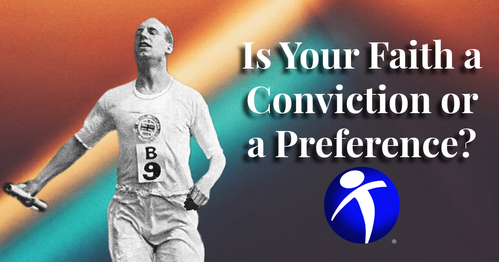
I love inspirational sports movies. Recently, my boys and I had a chance to watch an older one called Chariots of Fire. This 1981 film chronicles the story of two British athletes, Harold Abrahams and Eric Liddell, as they prepared for and participated in the 1924 Olympic Games. We really enjoyed the movie and were particularly impressed by the way the film showcased Eric Liddell’s faith.
Liddell was born overseas to a missionary family for the Scottish Congregationalist denomination. His family returned to Scottland prior to the 1924 games, and Liddell was given the opportunity to compete for Great Britain. He would ultimately return to the mission field and die there while interned in a Japanese prisoner camp near the end of World War II. While some aspects of his life were either played up or reimagined for dramatic effect, the film chronicles something that really did happen: Liddell withdrew from his strongest event, the 100m sprint, when he discovered that it would require him to race on Sunday. He believed that Sunday is the Christian Sabbath, and therefore that it is not a day for work or, importantly, for sports.
Liddell’s decision gave my boys and me a lot to talk about. “Is Sunday really the Sabbath day for Christians?” I asked. My boys knew that it wasn’t. There is no New Testament passage which changes the Sabbath day, which is Saturday, into Sunday, and there’s also no passage which says that Christians should treat Sunday like the Jews treated the Sabbath. While Sunday is the Lord’s Day (Revelation 1:10), the Old Testament idea of a Sabbath rest finds its fulfillment for Christians not in a restful day of the week but in an eternal rest with God in heaven (Hebrews 3:7-4:11). The fact that Christians in some places gathered on Sunday evening (e.g., Acts 20:7) may very well have been an accommodation for working Christians and/or slaves. Whether this is true or not, there is a fundamental difference between the Sabbath (a day of rest) and the Lord’s Day (a day of worship).
I shifted gears though. “If the church were meeting in a place where we were, and a sporting event or something like that happened at the same time, would it be OK to miss church?” And again, the boys knew that the answer was no, and I’m glad they did. I love the example of Paul in Acts 20. He was being chased by plotting Jews (Acts 20:3) and “was hurrying to be at Jerusalem, if possible, on the Day of Pentecost” (Acts 20:16), but when a late arrival in Troas caused him to miss the Sunday assembly, he “tarried” for a full “seven days” (Acts 20:6 ASV) so that he could catch the next assembly. Paul planned his life and his travel as best as he could around worship, and so should we.
I knew this shouldn’t be the end of the discussion though. “What if the Bible says something is OK, but we feel like it is wrong? What should we do then?” My boys were a little less certain about this question; a lot of people are actually. Reflecting on Liddell’s decision, I told them how the Bible says that sometimes we might feel like one day is different from another and certain things should or should not be done on that day, referencing Romans 14:5. In times like these, I said, the Bible says that God wants us to keep our consciences. Conscientiously believing that something is wrong could make it wrong for us, even if otherwise it would be something God allows (Romans 14:22-23).
While I wanted to make sure that my boys were able to work through the decision Liddell made through the lens of the Bible, I also wanted to uphold something powerful about Liddell’s example for them and for you too. While Liddell might not have understood the difference between the Old Testament’s Sabbath and the New Testament’s day of worship, he did understand something that a lot of people do not: faith is a conviction, not a preference.
What’s the difference between a conviction and a preference? A conviction is a decision that will not change under any circumstance regardless of the consequences. A perfect example of conviction on display in the Bible can be found in the words of Shadrack, Meshack, and Abednego (a.k.a. Hananiah, Mishael, and Azariah) as they replied to Nebuchadnezzar after he gave them another chance to worship the statue bearing his image. They said,
A preference on the other hand is different. A preference is a decision that, given the right circumstances or conditions, will change. Sometimes people confuse the two, because preferences can present themselves with great emotion, fervor, lip service, desire, and even great consistency under normal circumstances. However, when that one in a thousand or even one in a million moment comes that makes a preference too difficult to hold, a preference will be set aside.
So what really is faith: a conviction or a preference? The Hebrews author said, “Now faith is the assurance of things hoped for, the conviction of things not seen” (Hebrews 11:1 ESV). Every example of faith that follows in Hebrews 11 shows someone who was operating on the basis of conviction, not preference. Faith by its very definition is conviction.
I did a little bit of digging into Liddell’s story in the days after we watched the movie. The Hollywood retelling had Liddell finding out about the Sunday race only when enroute to Paris; the truth is, he knew about it months in advance. If anything, this actually makes the story more impressive. One hundred years after the 1924 Olympics, BBC retold Liddell’s story in an article by Greg McKevitt entitled, “‘It's complete surrender’ – Olympics hero Eric Liddell and the true story behind Chariots of Fire.” McKevitt reports the words of fellow athlete Greville Young regarding Liddell’s decision: “It caused tremendous furore amongst many people […] They were quite menacing almost and there were cries of, ‘He's a traitor to his country.’” Young added though, “He just accepted these things, and I never remember him being upset. He said, ‘It's just my belief. I don't criticise others about it, but I'm not going to run on the Sunday.’”
The BBC article’s title contains Liddell’s reported last words before he passed: “It’s complete surrender.” I can’t think of any better way of describing what faith should be, because this is what conviction is. In another article, I also found this quote that is attributed to Liddell: “You will know as much of God, and only as much of God, as you are willing to put into practice.” All I can say is… wow.
So, is faith a conviction for you? Is it one for me? Are we holding back pockets of our life from God’s reach, or was our decision to follow Jesus one of “complete surrender”? Jesus words seem to me to be an appropriate conclusion to these thoughts: “No servant can serve two masters; for either he will hate the one and love the other, or else he will be loyal to the one and despise the other. You cannot serve God and mammon” (Luke 16:13).
Liddell was born overseas to a missionary family for the Scottish Congregationalist denomination. His family returned to Scottland prior to the 1924 games, and Liddell was given the opportunity to compete for Great Britain. He would ultimately return to the mission field and die there while interned in a Japanese prisoner camp near the end of World War II. While some aspects of his life were either played up or reimagined for dramatic effect, the film chronicles something that really did happen: Liddell withdrew from his strongest event, the 100m sprint, when he discovered that it would require him to race on Sunday. He believed that Sunday is the Christian Sabbath, and therefore that it is not a day for work or, importantly, for sports.
Liddell’s decision gave my boys and me a lot to talk about. “Is Sunday really the Sabbath day for Christians?” I asked. My boys knew that it wasn’t. There is no New Testament passage which changes the Sabbath day, which is Saturday, into Sunday, and there’s also no passage which says that Christians should treat Sunday like the Jews treated the Sabbath. While Sunday is the Lord’s Day (Revelation 1:10), the Old Testament idea of a Sabbath rest finds its fulfillment for Christians not in a restful day of the week but in an eternal rest with God in heaven (Hebrews 3:7-4:11). The fact that Christians in some places gathered on Sunday evening (e.g., Acts 20:7) may very well have been an accommodation for working Christians and/or slaves. Whether this is true or not, there is a fundamental difference between the Sabbath (a day of rest) and the Lord’s Day (a day of worship).
I shifted gears though. “If the church were meeting in a place where we were, and a sporting event or something like that happened at the same time, would it be OK to miss church?” And again, the boys knew that the answer was no, and I’m glad they did. I love the example of Paul in Acts 20. He was being chased by plotting Jews (Acts 20:3) and “was hurrying to be at Jerusalem, if possible, on the Day of Pentecost” (Acts 20:16), but when a late arrival in Troas caused him to miss the Sunday assembly, he “tarried” for a full “seven days” (Acts 20:6 ASV) so that he could catch the next assembly. Paul planned his life and his travel as best as he could around worship, and so should we.
I knew this shouldn’t be the end of the discussion though. “What if the Bible says something is OK, but we feel like it is wrong? What should we do then?” My boys were a little less certain about this question; a lot of people are actually. Reflecting on Liddell’s decision, I told them how the Bible says that sometimes we might feel like one day is different from another and certain things should or should not be done on that day, referencing Romans 14:5. In times like these, I said, the Bible says that God wants us to keep our consciences. Conscientiously believing that something is wrong could make it wrong for us, even if otherwise it would be something God allows (Romans 14:22-23).
While I wanted to make sure that my boys were able to work through the decision Liddell made through the lens of the Bible, I also wanted to uphold something powerful about Liddell’s example for them and for you too. While Liddell might not have understood the difference between the Old Testament’s Sabbath and the New Testament’s day of worship, he did understand something that a lot of people do not: faith is a conviction, not a preference.
What’s the difference between a conviction and a preference? A conviction is a decision that will not change under any circumstance regardless of the consequences. A perfect example of conviction on display in the Bible can be found in the words of Shadrack, Meshack, and Abednego (a.k.a. Hananiah, Mishael, and Azariah) as they replied to Nebuchadnezzar after he gave them another chance to worship the statue bearing his image. They said,
“O Nebuchadnezzar, we have no need to answer you in this matter. If that is the case, our God whom we serve is able to deliver us from the burning fiery furnace, and He will deliver us from your hand, O king. But if not, let it be known to you, O king, that we do not serve your gods, nor will we worship the gold image which you have set up” (Daniel 3:16-18).
They said there was no need for an answer because the decision had already been made. Whether God would deliver them or not from the furnace did not matter; regardless of the consequences, they would worship no one but God. This is what conviction looks like.A preference on the other hand is different. A preference is a decision that, given the right circumstances or conditions, will change. Sometimes people confuse the two, because preferences can present themselves with great emotion, fervor, lip service, desire, and even great consistency under normal circumstances. However, when that one in a thousand or even one in a million moment comes that makes a preference too difficult to hold, a preference will be set aside.
So what really is faith: a conviction or a preference? The Hebrews author said, “Now faith is the assurance of things hoped for, the conviction of things not seen” (Hebrews 11:1 ESV). Every example of faith that follows in Hebrews 11 shows someone who was operating on the basis of conviction, not preference. Faith by its very definition is conviction.
I did a little bit of digging into Liddell’s story in the days after we watched the movie. The Hollywood retelling had Liddell finding out about the Sunday race only when enroute to Paris; the truth is, he knew about it months in advance. If anything, this actually makes the story more impressive. One hundred years after the 1924 Olympics, BBC retold Liddell’s story in an article by Greg McKevitt entitled, “‘It's complete surrender’ – Olympics hero Eric Liddell and the true story behind Chariots of Fire.” McKevitt reports the words of fellow athlete Greville Young regarding Liddell’s decision: “It caused tremendous furore amongst many people […] They were quite menacing almost and there were cries of, ‘He's a traitor to his country.’” Young added though, “He just accepted these things, and I never remember him being upset. He said, ‘It's just my belief. I don't criticise others about it, but I'm not going to run on the Sunday.’”
The BBC article’s title contains Liddell’s reported last words before he passed: “It’s complete surrender.” I can’t think of any better way of describing what faith should be, because this is what conviction is. In another article, I also found this quote that is attributed to Liddell: “You will know as much of God, and only as much of God, as you are willing to put into practice.” All I can say is… wow.
So, is faith a conviction for you? Is it one for me? Are we holding back pockets of our life from God’s reach, or was our decision to follow Jesus one of “complete surrender”? Jesus words seem to me to be an appropriate conclusion to these thoughts: “No servant can serve two masters; for either he will hate the one and love the other, or else he will be loyal to the one and despise the other. You cannot serve God and mammon” (Luke 16:13).
-Patrick Swayne
patrick@tftw.org
patrick@tftw.org
Posted in Christian Living
Posted in Christian Living, Conviction, Preference, Faith, Hebrews 11:1, Sabbath, Sunday, Lord\'s Day, Worship, Romans 14, Conscience
Posted in Christian Living, Conviction, Preference, Faith, Hebrews 11:1, Sabbath, Sunday, Lord\'s Day, Worship, Romans 14, Conscience
Recent
My Way and The Way Do Not Mix
September 11th, 2026
How To Keep Little Fires from Becoming Big Ones
September 1st, 2026
The Peace of Knowing the End from the Beginning
August 25th, 2026
The Shadow and Substance of Musical Worship
August 7th, 2026
Is Your Faith a Conviction or a Preference?
July 31st, 2026
Archive
2026
January
February
March
April
May
June
July
2025
January
March
April
May
June
July
September
October
November
2024
January
February
March
May
July